.:[Double Click To][Close]:.
Showing posts with label Nature. Show all posts

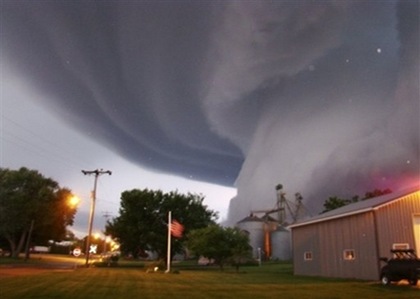
Lori Mehmen's Amazing Tornado Funnel Cloud Photo

Lori Mehmen s Amazing Tornado Funnel Cloud Photo

When a huge tornado funnel cloud touched down in Orchard, Iowa, Tuesday, June 10, 2008 at 9:04 p.m, Lori Mehmen took a life-a-time opportunity to capture this amazing photo from outside her front door. The funnel cloud which caused tree and crop damage came near the ground and then went back up into the clouds. Source: Chinadaily

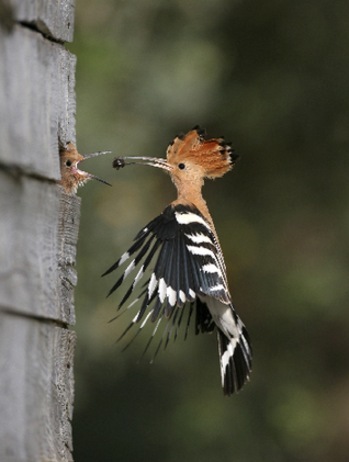
Hoopoe Chosen as Israel's National Bird

Israel national bird Hooppe picture
Picture source: Xinhuanet

The State of Israel finally has its national bird. The Hoopoe [wiki] (Duchifat--דוכיפת --in Hebrew), listed in the Old Testament as unclean and forbidden food for Jews, was selected as Israel's first national bird. Shimon Perez, the country's President, announced on Thursday. The pink, black and white-crested bird, among other candidates such as bulbul and red falcon etc. won a nationwide election held by the Society for the Protection of Nature in Israel since November. A total of 155,000 Israeli people participated in the voting, with 35% of them choosing Hoopoe as their national bird.  Source: Ynet & Reuters

Texas Daisetta Sinkhole (Picture)

Texas Daisetta Sinkhole -- The picture below of AP via BBC shows a giant sinkhole in Texas's Daisetta Town, Liberty County.

Texas Daisetta Sinkhole Picture

The massive Daisetta sinkhole believed to be as long as two football fields and up to 100 feet deep has swallowed vehicles and oil field equipment. It is still developing. Daisetta, a town of 1000 population, is a once booming oil town. The ground might have caved in because of the collapse of an old salt dome where oil brine and natural gas are stored underground. Link

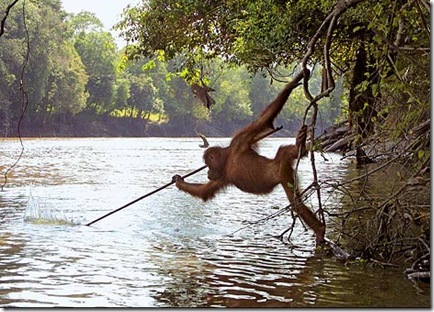
First Picture of Orangutan Hunting Fish with Spear

First Picture of Orangutan Hunting fish with Spear

In a new book titled The Thinkers Of The Jungle which will be published by Ullmann Publishing in UK on May 5, there is a world exclusive, extraordinary image--a male orangutan in Borneo on the island of Kaja photographed hunting fish with the spear! It is the first time the animal has been seen using a tool to hunt, demonstrating our long-armed cousins do indeed have a remarkable ability to mimic human being's behaviour. This unique orangutan who could catch fish already trapped in the fishing lines  learned his hunting skills from the locals they usually fished with spears on the Gohong River, Indonesia. Source: Dailymail

Mars Asteroid to Hit Red Planet?

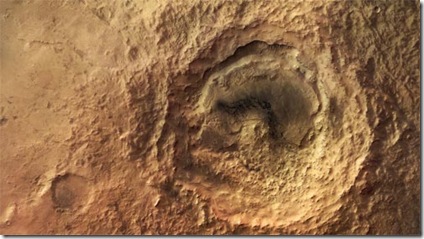
 Mars Maunder crater photo

Maunder Crater on Mars (photo credit:NASA)

Mars Asteroid! An asteroid named 2007 WD5 is to have a 1-in-75 chance of hitting Mars, the fourth planet from the sun in our solar system, on January 30, 2008.

If the asteroid with a length of an Olympic-size swimming pool (about 160 feet across) does hit the red planet, the impact of 2007 WD5, which travels at a speed of 28,000 mph, with Mars, will blast a crater half-a-mile wide, said Steve Chesley, a member of NASA's Near Earth Object office at JPL in Pasadena.

"Because scientists have never observed an asteroid impact -- the closest thing being the 1994 collision of comet Shoemaker-Levy with Jupiter -- such a collision on Mars would produce a 'scientific bonanza." Chesley told to the LAT.
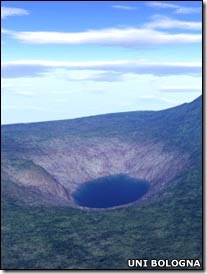
lake cheko deemed as tunguska event crater picture The asteroid which was traced only since November is about the size of one that exploded over Siberia in the Tunguska event of 1908 [wiki]. The force of that explosion, the equivalent of 10 million to 20 million tons of TNT, turned hundreds of square miles of forest into a flattened expanse of scorched logs. The left image is a computer-generated picture showing a 3D reconstruction of Lake Cheko [wiki] which scientists from University of Bologna in Italy claimed to be the crater left by Tunguska event.

Update: The possibility of Mars asteroid collision on January 30 is now very low, a January 9 update on the Near-Earth Object Program at the NASA's Jet Propulsion Laboratory said the impact probability is approximately 0.01% or 1 in 10,000 odds.

Since our last update, we have received numerous tracking measurements of asteroid 2007 WD5 from four different observatories. These new data have led to a significant reduction in the position uncertainties during the asteroid's close approach to Mars on Jan. 30, 2008. As a result, the impact probability has dropped dramatically, to approximately 0.01% or 1 in 10,000 odds, effectively ruling out the possible collision with Mars.

Our best estimate now is that 2007 WD5 will pass about 26,000 km from the planet's center (about 7 Mars radii from the surface) at around 12:00 UTC (4:00 am PST) on Jan. 30th. With 99.7% confidence, the pass should be no closer than 4000 km from the surface.

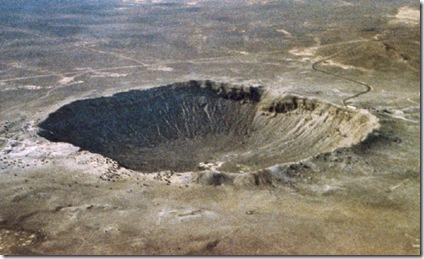
Impact craters are routinely scattered on the surface of moon, but not on the Earth. Meteor Crater in Arizona is one of the best known examples of an impact crater on Earth. The crater is 1.2 kilometers in diameter and 200 meters deep. It formed approximately 49,000 years ago when an iron meteorite that was roughly the size of a school bus struck the Arizona desert east of what is now Flagstaff (via).
picture of Meteor Crater in Arizona

Picture of Meteor Crater in Arizona (by David Roddy, USGS)

Another famous meteror crater on the Earth is Mexico's Chicxulub Meteror Crater on Yutachan peninsular, which was formed when a large asteroid/comet struck the Earth 65 million years ago and believed to be responsible for the die-out of Dinosaurs during the Cretaceous mass extinction. The following two pictures show the Chicxulub crater (via) and its location (via).

The Chicxulub crater picture Chicxulub crater yuchatan location picture

Source: LAT & Whittier

Video: Massive Ice Chunks Fall from 1600-Foot High TV Tower

This video remind everyone should pay attention to the melting ice in high buildings when passing by them. The high sky ice fall can really do some damages.

Naja Ashei, World's Largest Spitting Cobra Species Found

World's Largest Spitting Cobra Species found in Kenyan Bio-ken farm

Naja ashei, World's Largest Spitting Cobra

Conservationists from WildlifeDirect found a new spitting cobra species, Naja ashei, which is named after late James Ashe, a cobra expert who founded Bio-Ken snake farm in Watamu on Kenya's tropical coast. Growing up to nine feet (2.74m) and possessing enough venom to kill 20 people with one bite, Naja ashei, also known as a large brown spitting cobra, is the world's largest spitting cobra (king cobra is the world's largest venomous snake.

According to Herpetologist Wolfgang Wuster and Donald G. Bradley, this unique snake can be found in the dry lowlands of northern and eastern Kenya, northeastern Uganda, southern Ethiopia and southern Somalia. So whenever you or your friends travel to this area, please do pay attention to the risk of encountering such deadly cobra.

More pictures after jump:

longest spitting cobra naja ashei picturelongest spitting cobra naja ashei picture1longest spitting cobra naja ashei picture2

Source: National Geographic & Chinadaily. Click here and here to know the stories how the herpetologists found and identified Naja ashei. Tags: , , ,

Mummified Dinosaur With Clear Remains of Scales Found in North Dakota

Mummified Dinosaur photo

Fossilized hadrosaur Dakota skin picture (Tyler Larson/National Geographic)

The partially mummified hadrosaur [wiki], dubbed Dakota, were found in 2000 by Tyler Lyson, then a 17-year-old boy, on his uncle's ranch in North Dakota.

The creature is fossilized, with the skin and bone turned to stone. But unlike most dinosaur fossils, tissues are preserved as well.

Scientists believed the Dakota hadrosaur should be the most complete dinosaur ever found, with intact skin where clear remains of scales were visible.

"This is not a skin impression. This is fossilized skin," paleontologist Phil Manning of the University of Manchester said. "When you run your hands over this dinosaur's skin, this is the closest you are going to get to touching a real dinosaur, ever." Source: Reuters

Blue Sun in Egypt

blue_sun in egypt

When noticing the title of Blue Sun sets behind the Pyramids in Egypt at Redidt.com, I believed this may be a unique spectacular phenomenon of the Sun, but it seems not, it's a result of air pollution. From Coasttocoastam.com

PyramidCam captures a live image of the pyramids every 30 seconds. This particular image, saved by Tom Hartlove on December 14, 2006, is one of only a few ever documented occurrences of a blue sun. Tom happened to run across the image a few days ago in his photo archives and sent it to an expert in atmospheric physics to find out what might have caused it. Here was the reply:

"A very rare phenomenon known as a 'blue sun.' These have been observed from time to time around the world. The most recent widely accepted documentation of a blue sun occurred in September 1950 in Edinburgh, Scotland. A discussion of that event appears in Craig Bohren's book, 'Clouds in a Glass of Beer,' on page 91."

The main cause is thought to be smoke in the atmosphere. From time to time smoke from farmers burning brush between the camera location and the pyramids' plateau rises to camera level and is apparent on many of our images. We have also captured long plumes of smoke visible behind the pyramids, particularly in winter when farmers burn stubble in the fields in the Delta and around Cairo.